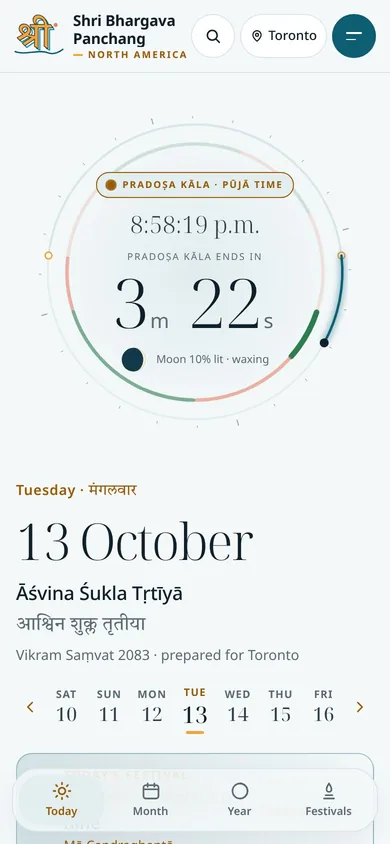
The Moon
चन्द्र95% lit · waning
Why Moonrise opens the fasts of Karwa Chauth, Sankashti and Purnima; the Moon’s rashi is the sign read in your Rashiphal.
Krishna Tritiya
कृष्ण तृतीया
Moon 92% lit · waning
The day in the order it is kept, from dawn to night — every hour prepared for Toronto.
Thursday is kept for Brihaspati and Vishnu
ॐ बृहस्पतये नमः
Why Prayer is set at the joins of the day — dawn, midday and dusk, the three sandhyas — when one part of the day hands over to the next.
Don’t begin a journey toward the south today.
Why Disha Shula — each weekday has one direction the tradition asks a traveller not to begin toward. If the road must run that way, take a few steps in another direction first, then set out.
Why Abhijit is the muhurta around local midday, held good for starting work, a journey or a purchase.
For those who keep the weekly vow: Thursday vrat for Brihaspati — one meal of yellow foods after the evening puja (4:44 p.m.).
Why A vrata is a vow rather than hunger: when and how it is opened matters as much as the fast itself.
Kept as living heritage. Where a household follows a different school, that reckoning stands.
The Creator’s hour: the last stretch of night, about an hour and a half before sunrise, when the air and the mind are still.
Wake, wash and sit — japa, prayer or study. What is learned or prayed in this hour is said to stay.
One eighth of the daylight, ruled by Yama, son of the Sun. Its place in the day moves with the weekday.
Let it pass for new beginnings, journeys and signatures. What is already underway carries on.
One eighth of the daylight, ruled by Gulika, the son of Shani. Its place in the day moves with the weekday.
What begins now tends to repeat. Start here only what you would gladly do again; leave loans, quarrels and the like for another hour.
“The victorious”: the eighth of the day’s fifteen muhurtas, centred on your local noon.
The hour to begin what matters when no other muhurta can be found. Many families do not use it on a Wednesday.
One eighth of the daylight, ruled by Rahu, the shadow graha. Its place in the day moves with the weekday.
The window most widely let pass: no new work, journey or purchase begins now. Daily prayer and work already underway go on.
The twilight after sunset, when Shiva is said to dance — the hinge between day and night.
Light the evening lamp: sandhya, arti and puja belong here. On Trayodashi this is the hour of the Pradosha vrat.
Sunrise to sunset is cut into eight equal parts, and sunset to the next sunrise into eight more: sixteen in all, each about an hour and a half — longer by day in summer, shorter in winter.
Amrita, Shubha and Labha are good to begin in; Cara is good for travel. Udvega, Roga and Kala are let pass. Find the time you need and read its colour — green to go, coral to wait. The row marked Now is where you stand.
Krishna Tritiya कृष्ण तृतीया
Until 11:18 p.m. · then Krishna Chaturthi
Why The Moon’s own day — it fixes the date of every vrat and festival.
Guruvara गुरुवार
The day of Brihaspati
Why Each day is ruled by a graha; its devotion follows.
Ardra आर्द्रा
Until 4:38 a.m. Fri · then Punarvasu
Why One of the 27 star-mansions the Moon walks through — the root of muhurta.
Sadhya साध्य
Until 5:13 p.m. · then Shubha
Why The Sun’s and Moon’s motion together, read as the temperament of the day.
Vanija वणिज
Until 1:00 p.m. · then Vishti
Why Half a tithi; the smallest of the five measures. Vishti, also called Bhadra, is let pass for anything new.
Every month the Moon walks away from the Sun and back again. Each 12° of that walk is one tithi — thirty in all.
Krishna Tritiya is step 3 of the waning Moon — a Jaya tithi, “victory”, whose deity is Gauri. Fasts, festivals and shraddha follow the tithi, not the calendar date.
The day from one sunrise to the next, each ruled by one of the seven grahas.
Guruvara belongs to Brihaspati. Traditionally kept for Vishnu and Brihaspati, the guru — for learning, teachers and elders.
The sky cut into 27 star-mansions of 13°20′. The Moon walks through about one a day, the whole ring in about 27 days.
Ardra, “the moist one”, whose deity is Rudra. A sharp star — for cutting away what must end.
Add the Sun’s longitude to the Moon’s and cut the circle into 27: each part is a yoga — the day’s temperament.
Sadhya means “the attainable” — a favourable yoga.
Each tithi has two halves; each half is a karana. Seven turn in a cycle; four come only once a month, around the new Moon.
Vanija is one of the seven moving karanas, generally good for ordinary work.
95% lit · waning
Why Moonrise opens the fasts of Karwa Chauth, Sankashti and Purnima; the Moon’s rashi is the sign read in your Rashiphal.
Saturday, 20 February 2027 · penumbral lunar eclipse
A penumbral eclipse: the Moon only dims a little. It carries no sutaka; the times are given for those who wish to watch.
Why Only a grahan your own city sees is kept. On the day itself this card comes to the top of the page.
Today, every hour and every festival — for your own city, in English, Français, Español, हिन्दी, मराठी, नेपाली, ગુજરાતી, ਪੰਜਾਬੀ, বাংলা, ଓଡ଼ିଆ, தமிழ், తెలుగు, ಕನ್ನಡ, മലയാളം.
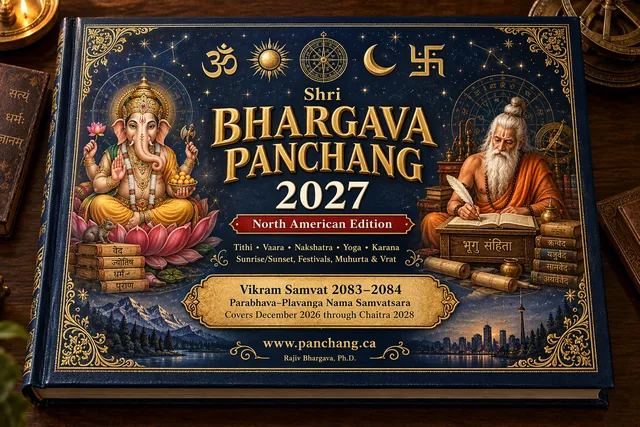
See the app → See it in printThe year on paper — every sunrise, tithi and festival for North America, for the home shrine.
The printed Panchang →Try “Diwali”, “Ekadashi”, “Brampton” or “privacy”.